How Bellerive CC Became The Youngest US Open Host Site
How Bellerive left its own golf course, took a major away from San Francisco, and kept doing it for sixty years.
By The Historians Archive
August 23, 2026 · 12:00 PM ET
8 min read
The best players in the world finish the BMW Championship at Bellerive today, on a golf course that by every normal rule of golf history should never have gotten the chance to matter. Bellerive is not an old links pieced together by a dead architect and preserved under glass. It is a course that exists because a club sold its land, moved across a city, hired the most divisive architect in America, and then — five years after opening — talked the U.S. Open away from a club that had already been promised it.
That last part is the story most people have never heard.
A mayor, a phone call, and the youngest Open venue ever
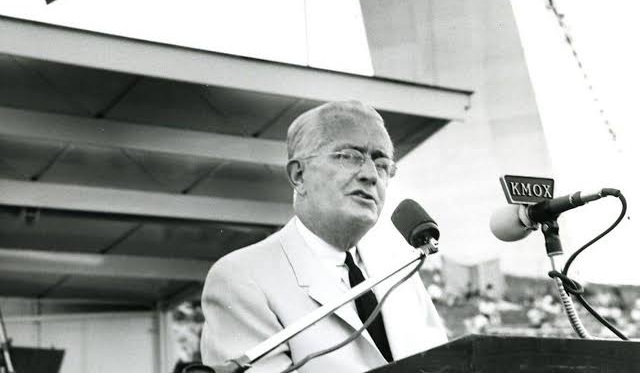
In 1963 the mayor of St. Louis, Raymond Tucker, wanted a showpiece for the city's upcoming Bicentennial Celebration. He knew almost nothing about how the USGA awarded a U.S. Open, which turned out to be an advantage. He went to Hord Hardin — a Bellerive member and a sitting member of the USGA Executive Committee — and suggested, more or less casually, that it would be nice if Bellerive hosted the 1965 U.S. Open.
Hardin had to explain the obvious problem: 1965 was already promised to the Olympic Club in San Francisco.
Tucker was unbothered. As the story is preserved in the club's own history, his reply was essentially, "Oh, I'll call Mayor Christopher. I'm sure he won't mind giving the event to us."
Somehow, that worked. The Olympic Club took 1966 instead. Bellerive — barely five years old, grass still settling — became the youngest course ever to host a U.S. Open. A mayor who did not understand the process simply picked up the phone and moved a major championship 1,800 miles.
Why there was a new course to give it to
The Bellerive of 1965 was not the Bellerive of 1897. The club had been founded in the last years of the nineteenth century and lived for decades on ground near Lambert Field. By the mid-1950s the city had grown up around it and the airport had grown louder. On March 4, 1955, the membership voted to do the thing most private clubs never manage: leave.
Four months later, on July 7, 1955, a McDonnell Aircraft fighter plane on a test flight went down near the 13th green of the old course, killing the pilot. The vote had already passed. But it is difficult to imagine a more emphatic confirmation that the club's future was somewhere else.
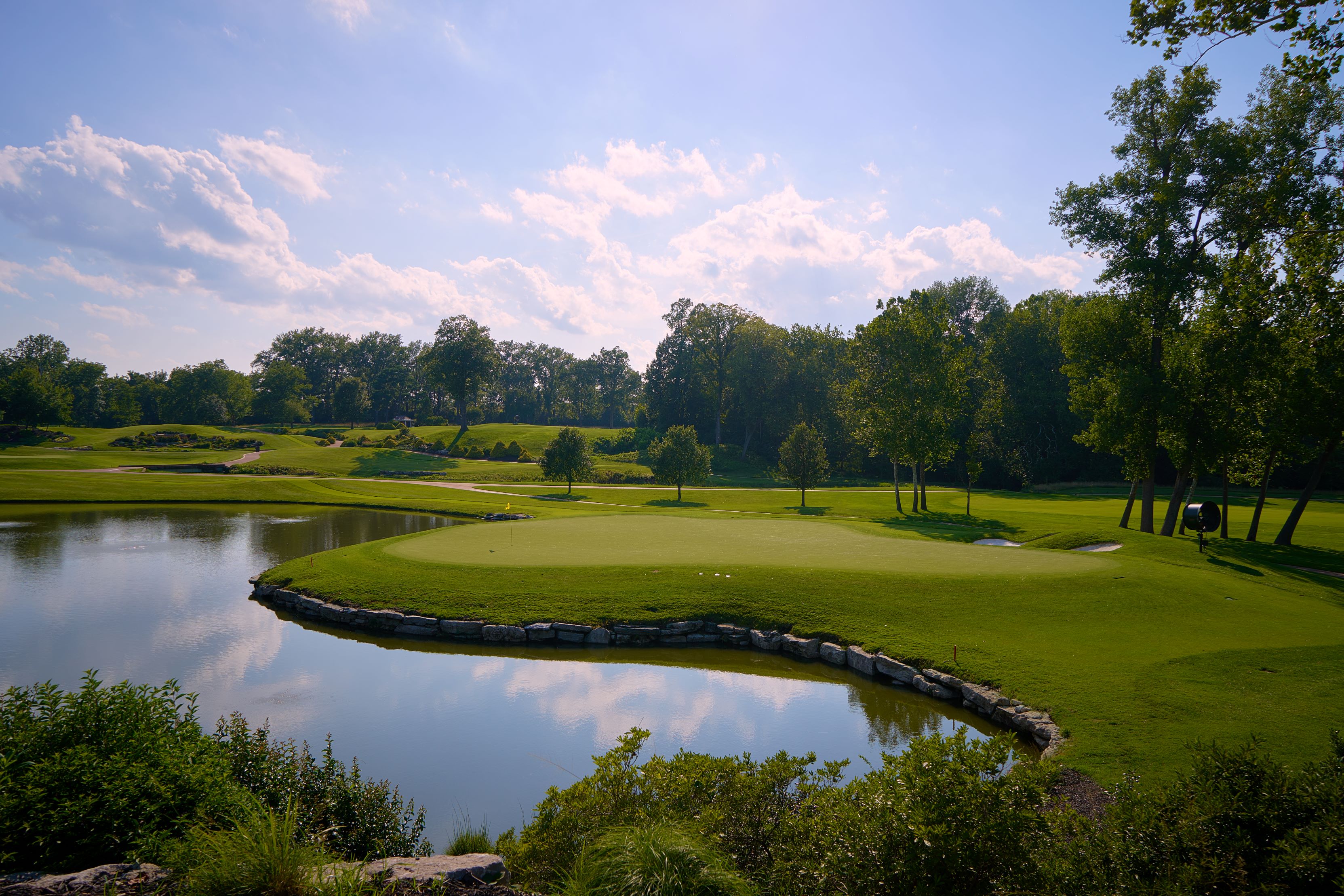
For the new ground in West County the club hired Robert Trent Jones Sr., then at the height of his influence and his controversy. Jones built what he built everywhere: runway tees, enormous bunker complexes, and greens big enough to look generous from 200 yards and cruel once you were on them. His stated philosophy — "a hard par and an easy bogey" — is the sentence that still explains Bellerive to anyone standing on the first tee. The course opened in 1960. Five years later it had the U.S. Open.
1965: the week the long hitters were wrong
Everyone arrived at Bellerive in June 1965 with the same theory. At 7,191 yards it was the longest Open venue anyone had seen, so the bombers would win. The theory lasted about a round.
The first-round leaderboard was full of short, straight players: Kel Nagle, the amateur Deane Beman, Rex Baxter, and a 29-year-old Gary Player. The field averaged 77.29. Jack Nicklaus shot 78. Arnold Palmer shot 76, missed the cut, and ended a run of 98 consecutive cuts and 51 straight tournaments in the money.
Palmer, sitting in the locker room afterward, said the quiet part out loud: "I'm baffled. I still don't believe the course is that tough, but obviously it is. I still think it's a great golf course. I still think I can score on it. Maybe one of the reasons I didn't score on it is because I don't think it's tough."
That is the whole Trent Jones argument in one paragraph. The yardage was a decoy; the strategy was the test.
Player's ritual, and the third Grand Slam in history
Player came to St. Louis needing only a U.S. Open to complete the career Grand Slam — a thing only Gene Sarazen and Ben Hogan had ever done. He believed Nicklaus would get there first and had made his peace with it.
Once he took the lead on Friday he refused to change a single variable. He found a nearby church and attended every morning before his round. He hand-washed, dried and ironed his black shirt each night. And he lifted weights after every round — in 1965, when the accepted wisdom across nearly every sport was that in-season lifting would destroy your muscle memory. "I had never felt as strong as I felt that week," he said later. "Each day I just felt like there was nothing I could not overcome."
He shot 70-70-71-71. Nagle caught him on Sunday with a closing 69. The 65th U.S. Open went to a Monday playoff.
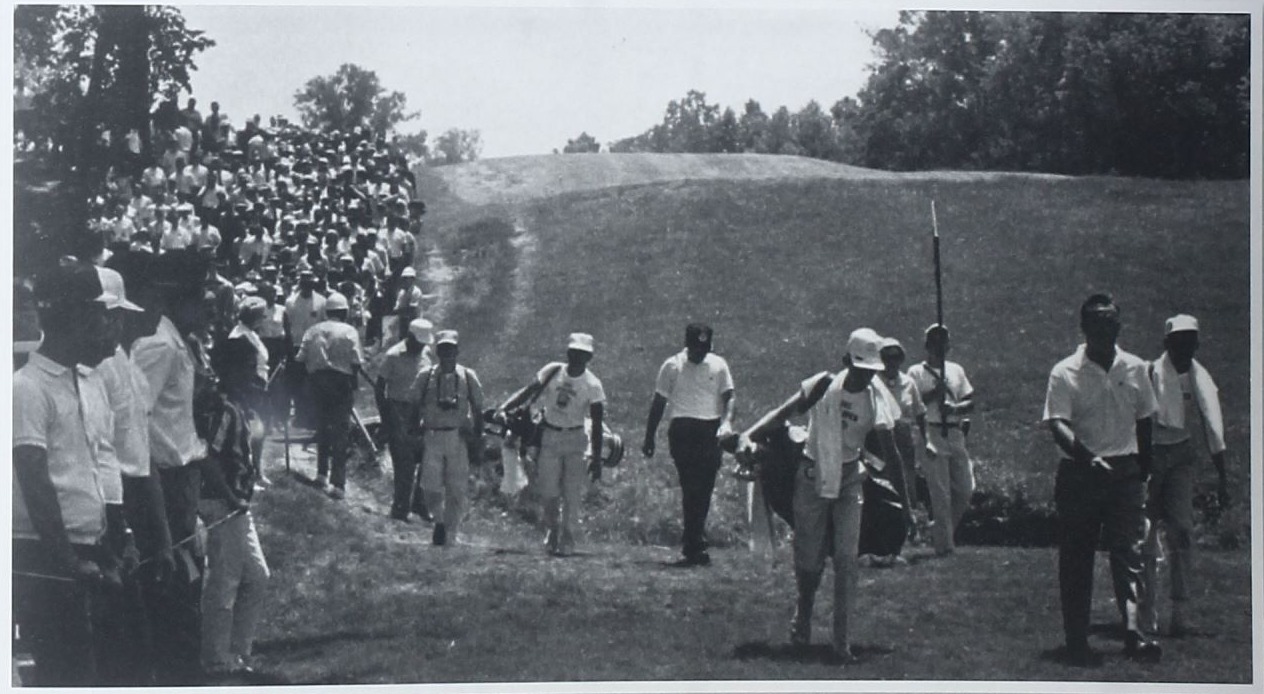
Then a thunderstorm hit. The creek down the 17th fairway swelled into a 50-foot-wide stream and put half the fairway underwater. The creeks on the front side broke their banks. And on Monday morning more than 13,000 people showed up to watch two men play golf — so many that the bridges could not hold them and spectators waded through the creeks to follow the group from hole to hole.
Player shot 71 for the fourth straight time. Nagle shot 74. It was over.
What happened next is the part that should be better known than it is. Player donated his entire $25,000 winner's check to the USGA — $20,000 to junior golf, $5,000 to cancer research. Then he wrote a $2,000 check to his caddie, Frank Pagel, a Ritenour High School student who had drawn Player's name out of a caddie pool because 1965 was the last U.S. Open played without tour caddies. Every local kid had hoped for Palmer or Nicklaus. Pagel got the guy who won and gave the money away.
A few other firsts that week: it was the first Open to finish on Sunday rather than with a 36-hole Saturday, and the first televised in color — holes 16, 17 and 18, with the fairways dyed green so they would read properly on camera.
1992: a videotape wins a PGA Championship
Bellerive went after the 1992 PGA Championship the way a company goes after a contract. Club president Leo Peck put Dick Shoemaker in charge, and the committee understood the real problem: every club bidding had a good clubhouse, good parking, and a good course. Differentiation was the whole game.
Bob Mason suggested a video. With production help from Maritz, they built a thirteen-minute film hosted by St. Louis broadcaster Jay Randolph, with two-time U.S. Open champion Hale Irwin walking the holes and explaining exactly how the course would defend itself against the best players in the world. Then they filmed the men who ran St. Louis: Sandy McDonnell of McDonnell Douglas, Chuck Knight of Emerson Electric, Dick Mahoney of Monsanto, and August Busch III of Anheuser-Busch — the PGA Tour's largest sponsor — each pledging the city's support.
The committee walked into the room at Inverness and requested exactly one piece of equipment: a VCR. Thirteen minutes later the presentation was effectively finished. Bellerive was awarded the 1992 PGA within weeks.
The championship itself gave the club a piece of tour folklore. Nick Price had withdrawn from the 1991 PGA when his wife went into labor, freeing both his spot and his caddie, Jeff "Squeaky" Medlen — who then looped for John Daly's legendary win at Crooked Stick. In 1992 Squeaky was back on Price's bag, and Daly had to find someone else. Price drove the ball beautifully all week, shot 70-70-68-70 for 278, and won his first major at 35. On the range beforehand, Daly had been hitting drivers over the net onto Ladue Road; Nicklaus needled him about his oversized driver head, Daly borrowed Jack's club and reached the road anyway, and Nicklaus took Daly's "big dog" and did the same. The 1965 Open produced a Grand Slam. The 1992 PGA produced a driving contest between two generations in front of Sarazen and Byron Nelson.
2008: the tournament a hurricane could not stop
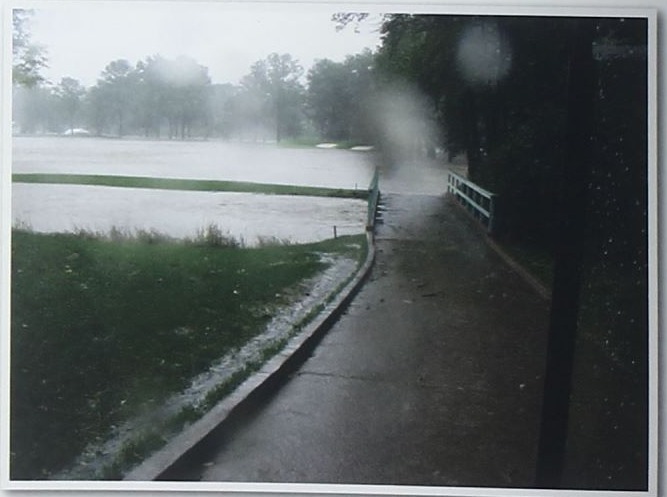
When the BMW Championship came to Bellerive in September 2008, the remnants of Tropical Storm Gustav arrived with it. Public parking lots closed. Thursday's opening round was cancelled outright. Officials rebuilt the schedule around a 36-hole Sunday.
The golf that eventually happened was outstanding. Jim Furyk shot 62. Sergio García made an ace at the 3rd. And Camilo Villegas — reading putts in the spider-man crouch that made him briefly the most recognizable player in the game — went 65-66-66-68 for 265, 15 under, and held off Dudley Hart, Furyk and Anthony Kim for the first PGA Tour win of his career. He was 26: three years younger than Player was in 1965, nine years younger than Price in 1992. Three weeks later he won the Tour Championship.
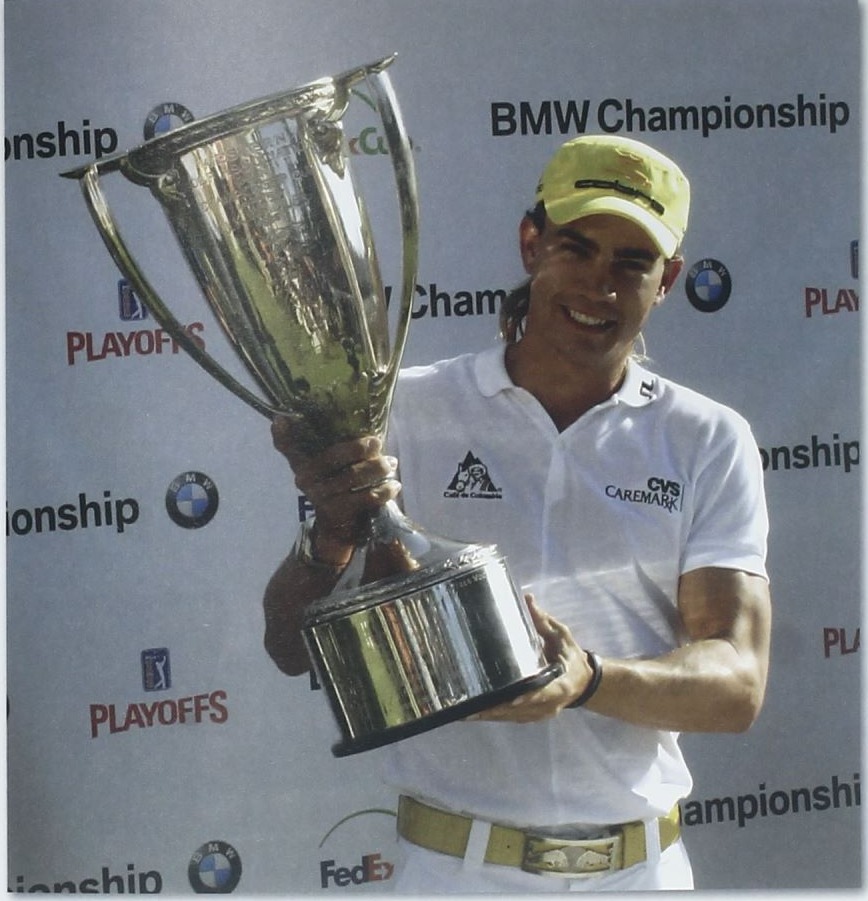
Tiger Woods was absent that year, and everyone assumed the week would suffer for it. It did not. That, more than any leaderboard, is what the club took from 2008.
What today is actually about
Add it up. A U.S. Open won for a career Grand Slam and then given away to charity. A PGA Championship won by a videotape before a shot was struck. A BMW Championship completed in spite of a hurricane. A 2004 U.S. Senior Open, a Mid-Amateur, a Western Amateur, and the 2018 PGA Championship, where Brooks Koepka held off Tiger Woods in front of one of the loudest galleries of the modern era.
None of it was inherited. Bellerive got every bit of it by deciding, repeatedly, to go and take it — starting with a membership that voted to abandon its own golf course, and a mayor who did not know he was supposed to ask nicely.
When the final group walks up the 18th today, that is the ground they are walking on: not a museum, but a club that has never once waited to be chosen.
Originally published
Read this piece on Club Docket →