East Lake and the Making of Bob Jones
From a six-hole neighborhood tournament to the course record cup he never gave back — the East Lake years that built the greatest amateur in golf.
By The Historians Archive
August 27, 2026 · 8:00 AM ET
10 min read
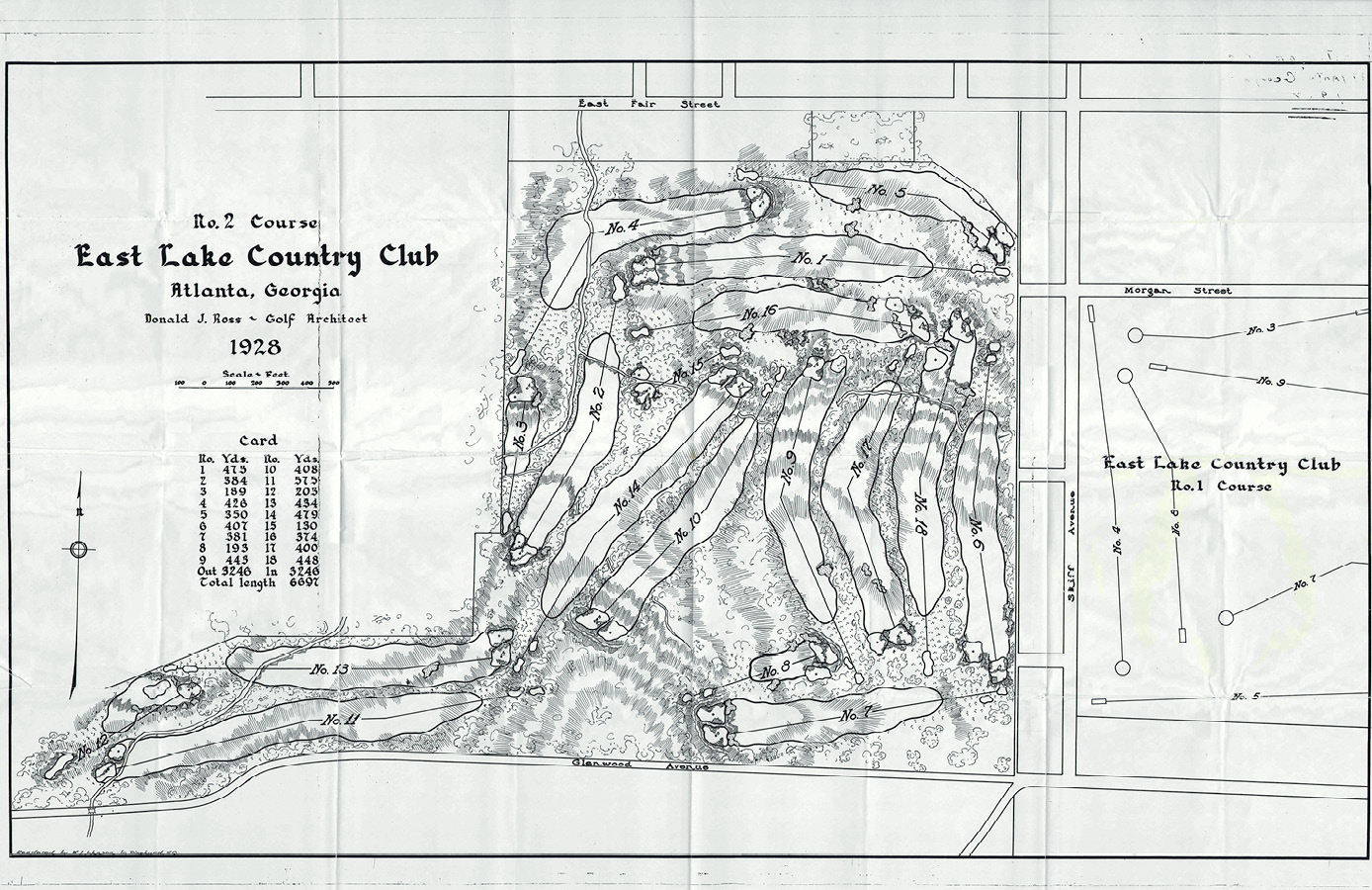
Almost every great player is associated with a course. Very few are inseparable from one. Bobby Jones and East Lake Golf Club are inseparable — not because he won championships there, though he won plenty, but because East Lake is where the swing, the temperament, and the competitive mind were assembled, piece by piece, between the ages of five and twenty-eight.
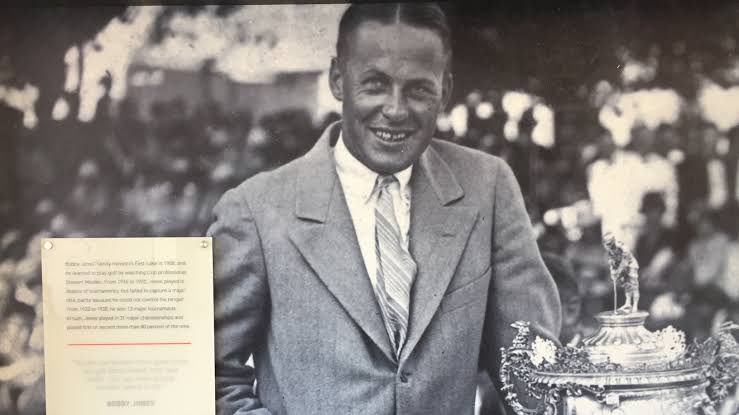
The club's own history, preserved in our archive from Where Bobby Learned To Play by Linton C. Hopkins and the Atlanta Athletic Club's 1984 history, states the case without exaggeration: no golf course "can claim the soul of Bobby Jones to the same extent as East Lake. It saw the start of his golfing life at age five and his last round." St. Andrews, Hoylake, Interlachen, and Merion hold his Grand Slam. East Lake holds everything that made it possible.
The Boy Who Lived Off the Second Fairway
The Jones family summered in a house near the course. A member named Fulton Colville — his name survives in the club's earliest golfer rolls alongside Colonel and Mrs. Robert P. Jones "and son Bobby" — gave the boy his first club. He was six years old the first time he played competitive golf, and he won.
The First Trophy He Didn't Think He Deserved
That first event was a neighborhood affair, six holes, arranged by Mrs. Frank Meador among four children: her son Frank, Perry Adair, a girl from down the road named Alexa Stirling, and Bob Jones. A small silver cup went to the winner. Jones took it — and spent the rest of his life insisting the arithmetic was wrong.
"Bob always believed that Alexa, and not him, was entitled to the little silver cup given as a trophy. But Frank Meador had it figured that Bob won the cup."
The detail matters for two reasons. First, because it is the earliest recorded instance of the scrupulousness that would later define him — the man who called penalties on himself in national championships was already auditing his own scorecard at six. Second, because of who finished ahead of him. Alexa Stirling grew up on the same ground, learned the same swing, and won the U.S. Women's Amateur three years running. East Lake was not producing one prodigy. It was producing a generation.
His second tournament went to Perry Adair in the final — 36 holes, the boys handicapped by age, Jones getting one stroke and winning 2 and 1 on the 35th green, the whole thing played in about four hours while regular foursomes stood aside to let them through. What he called his "first big cup" came at nine: the Atlanta Athletic Club Junior Championship, in which he beat Howard Thorne, seven years his senior, 5 and 4.
Stewart Maiden, and a Swing Learned by Watching
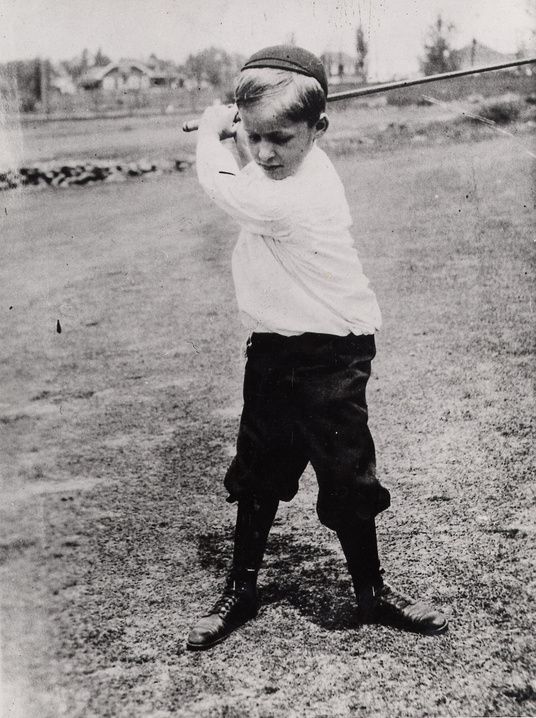
Jones never took a formal lesson. Not one, by his own account, on or off the practice tee. What he did instead was follow the club's Scottish professional, Stewart Maiden of Carnoustie, around East Lake and copy what he saw.
"I used to follow Stewart Maiden all around the course and watch him play, and unconsciously fashioned my swing after his. I never had a formal lesson from him or anyone else… Occasionally I'd get in trouble and ask him to watch me hit a few and make some suggestions, which was usually enough. It would take about five minutes." — Bob Jones
He was seven or eight when he adopted what the club still calls the "Maiden swing," and he carried it, essentially unchanged, through thirteen national championships. Contemporaries described it as "the smoothest, easiest stroke, almost poetry in its rhythm." That rhythm was not invented in a coaching bay. It was absorbed by a child walking behind a Scotsman on a Donald Ross golf course in Georgia.
East Lake's professional lineage helps explain the standard. Alex Smith of Carnoustie was the club's first head professional. Maiden followed. So did 1909 U.S. Open champion George Sargent, and later Sargent's son Harold, who became president of the PGA. A boy walking that property in 1910 was surrounded by working craftsmen of the game.
The 13th Green, Where the Short Game Was Built
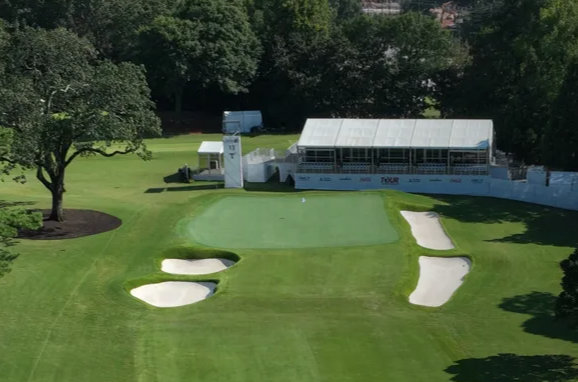
The single most revealing habit in the whole record has nothing to do with tournaments. After following Maiden for a few holes, Jones would walk home to the 13th green with a cap full of golf balls and pitch to the flagstick, then hole out, for hours.
"Through all my career, I've never been able to pitch a ball as accurately as I could pitch it to the flagstick on that green."
That is one boy, one green, one repeated shot, thousands of times, on the ground he lived on. Modern practice science has a vocabulary for it now. Jones simply had a green in his backyard and nowhere else he wanted to be.
Taking Over the Course Record Cup
East Lake kept an engraved cup for the course record, and reading it in order is like watching a door slowly close on the rest of the membership. A.H. Adair, 79, November 8, 1914 — an amateur record set just after the course was remodeled into Ross' present form. D.E. Root, 78, July 2, 1915. Then the entries stop varying: R.T. Jones, Jr., 77 — July 7, 1915. 74 — July 4, 1916. 70 — July 18, 1918. 69 — July 16, 1919. 68 — September 11, 1919. 66 — September 13, 1920.
"Then Bob Jones took charge of the cup — and I suspect he will hold it from now on."
He held the club championship the same way. George Adair won it in 1913, Perry Adair in 1914, and then Jones won three straight and took permanent possession of the trophy under its three-wins rule. His comment on the matter is characteristically flat: "I never played in the club championship any more after that." It was, he said, one of the two cups he was proudest of — out of more than 150 major trophies and medals.
September 16, 1922: The 63
The round that defines Jones at East Lake came in the worst stretch of his career. O.B. Keeler later called 1916 through 1922 the "seven lean years" — all that promise, no national title. A week before, Jones had been beaten again. He would give up golf for the season shortly after.
On a Saturday evening in the cool of mid-September, playing with his father, Tess Bradshaw, and Abe Adair, he shot 63 on a course measuring 6,570 yards from the back tees, par 36-36—72. Out in 31, home in 32. Nine birdies, nine pars. No eagle, no bogey. Twenty-six putts: twelve going out, fourteen coming in, all holed.
The fifth was a 590-yard par five that day. He drove it 310 yards, hit a brassie 260 to the edge of the green, and chipped dead for his fourth birdie — through five holes. The finish, in near darkness, was the 18th at 205 yards: driving iron, no wood, just off the green right, chip dead, one putt.
"You are not likely to see its like again. The bright Genius of Golf was on the blond brow of Bobby Jones the afternoon of Saturday, September 16, 1922, and the record he set at old East Lake, toughest championship course of the southland, is likely to endure until our generation has passed away." — O.B. Keeler, The Atlanta Journal, September 17, 1922
Jones' own explanation was quieter, and truer to how he played: "That usually is the way, though. Your best scores come easily. You can't force them. When you work hard you don't score well. The ball rolls for you — or it doesn't." He admitted to one moment of nerves, on the last tee, in the dark, thinking of everything that could go wrong with the shot. Then he hit it.
The Ledger East Lake Kept
Keeler treated it as a turning point, and the record bears him out. Almost exactly eight years later — Saturday, September 27, 1930, at Merion — Jones won his fifth U.S. Amateur and completed the Grand Slam. Thirteen national championships in eight years, roughly sixty-two percent of the ones he entered. He retired at twenty-eight, the only person to receive two ticker-tape parades on Broadway.
The club recorded his majors the way a family records births. U.S. Open: 1923, 1926, 1930 — R.T. Jones, Jr. U.S. Amateur: 1924, 1925, 1927, 1928, 1930 — R.T. Jones, Jr. Every one of them was won elsewhere and belonged, in the club's accounting, to East Lake.
Harry Atkinson, who sold the property that became the club, understood what he had done only in retrospect. He had told George Adair he could visualize "another St. Andrews" on the site — but, he admitted years later, "I never saw, even in the rosiest moments of the vision, an Alexa Stirling, a Bobby Jones, who were to carry East Lake to the top of the world as a home of golf, a place in the sun shared only with St. Andrews."
After the Slam
Retirement did not end the association. Jones founded Augusta National and designed its course with Alister MacKenzie, later built a course with Robert Trent Jones, and remained an Atlanta figure — an opera subscriber, a lawyer, a man friends remembered for deflecting his own legend. Asked endlessly who the greatest player was, he waved off the parlor game: "The only thing you can do is beat the people playing against you; there's no way you can work on somebody who died before you were born."
A story from 1937 catches him whole. Watching the U.S. Amateur in Portland with Charlie Yates and Tommy Barnes, he praised a recovery shot by Ray Billows loudly enough for the gallery to hear: "I don't think anyone in the world but Ray Billows could play that shot." An old man nearby snapped that he didn't know what he was talking about — Bobby Jones could do that with his eyes closed. Jones smiled. "I'm certain that he could not."
The course itself changed after him. George Cobb lengthened holes, added bunkers, and converted the greens from Bermuda to bentgrass. In 1994 Tom Cousins and Rees Jones rebuilt it toward Ross' original feel, and Andrew Green's recent restoration went further still. But the routing is the one Ross drew in 1913, the 13th green is still there, and every year the best players in the world walk it.
They are playing, whether they think about it or not, on a boy's practice ground.
Originally published
Read this piece on Club Docket →