East Lake's Championship Century: From Bobby Jones' 63 to the FedExCup Finale
As the TOUR Championship returns to Atlanta, a look at the 113 years of consequential golf that made East Lake the season's proper ending.
By The Historians Archive
August 26, 2026 · 10:00 PM ET
9 min read
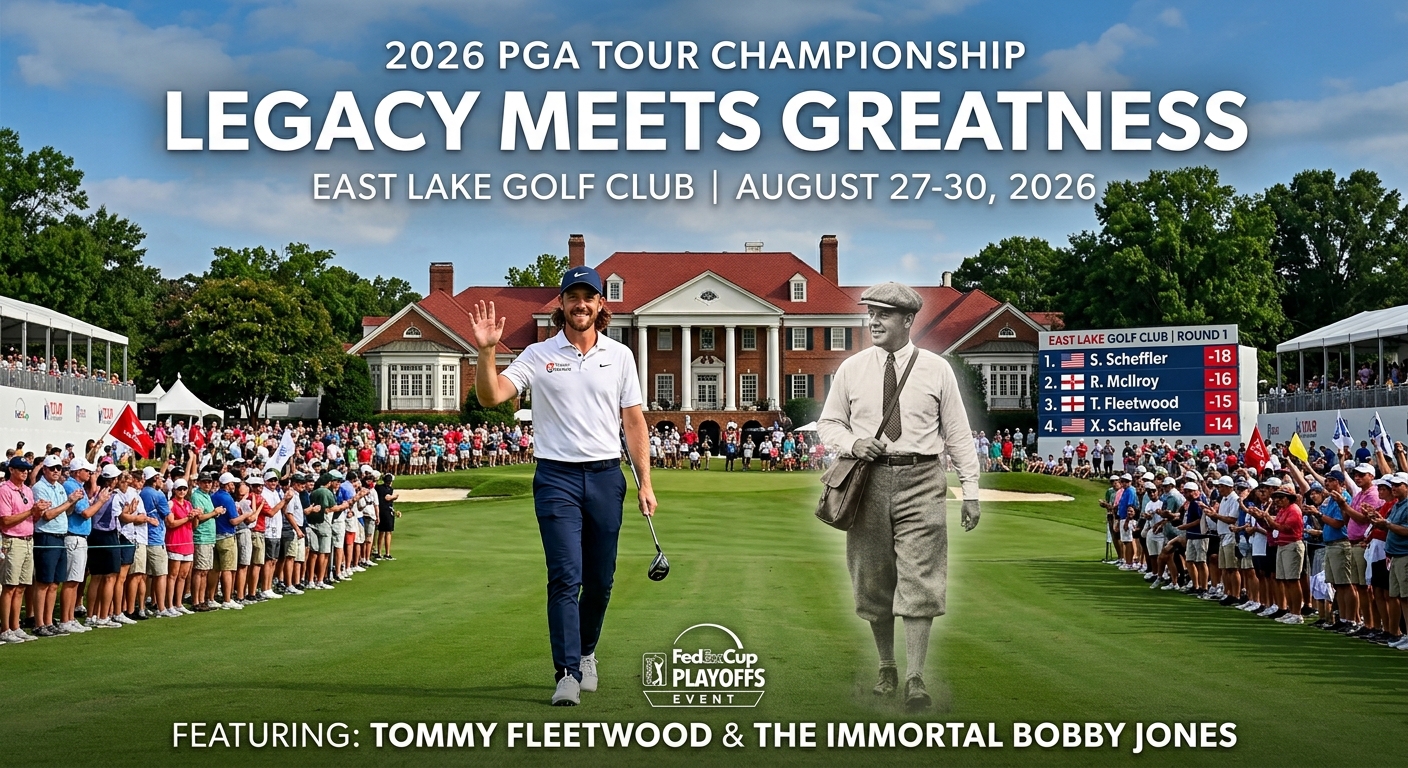
When the 30 best players of the PGA TOUR season tee it up at East Lake Golf Club this week for the TOUR Championship, they will be walking ground that was hosting consequential golf before the FedExCup, before the Ryder Cup came to Atlanta, and before most American clubs had a bentgrass green to putt on. East Lake's championship history does not begin in 2004, when the TOUR Championship settled here permanently. It begins in 1913, when Donald Ross laid out the course that a boy named Robert Tyre Jones Jr. would treat as his personal laboratory.
A Championship Ground Before It Was a Championship Venue
The club's own history — preserved in the archive material we hold from Where Bobby Learned To Play by Linton C. Hopkins and the 1984 club history — makes the point plainly. East Lake, the books note, is "the site of the 1963 Ryder Cup and the 1998 Tour Championship," the course "Donald Ross created in 1913," and the home of a Philip Shutze clubhouse that is a piece of Atlanta architecture in its own right. Championship golf at East Lake is not an event the club rents out. It is something the property has been doing, in one form or another, for more than a century.
Jones and the Making of a Championship Course
The earliest "championships" at East Lake were the club's own, and the scoreboard is engraved in the record the archive preserves. The course record cup lists A.H. Adair at 79 on November 8, 1914, "a new amateur record for the course just after it was remodeled in its present form," then D.E. Root at 78 in July 1915. After that, one name simply takes over: R.T. Jones, Jr., 77 in July 1915; 74 in July 1916; 70 in July 1918; 69 and then 68 in 1919; 66 in September 1920.
The line the club's historian added is one of the great understatements in American golf writing: "Then Bob Jones took charge of the cup — and I suspect he will hold it from now on."
"The bright Genius of Golf was on the blond brow of Bobby Jones the afternoon of Saturday, September 16, 1922, and the record he set at old East Lake, toughest championship course of the southland… You are not likely to see its like again." — O.B. Keeler, Atlanta Journal, on Jones' 63
Keeler's hole-by-hole account of that 63 survives in the archive, right down to the finish: "No. 18. 205 Yards, Par 3 — Driving iron just off green at right. Chip dead. One putt." The course played 6,570 yards from the back tees that day, par 36-36—72, and Jones needed only 26 putts. Eight years and one month later, at Merion, he closed out the Grand Slam with his fifth U.S. Amateur — thirteen national championships in eight years, roughly sixty-two percent of the ones he entered. Every one of them was built on the ground the TOUR will play this week.
1963: The Ryder Cup Comes to Atlanta
East Lake's first true international championship arrived in October 1963, when the club hosted the Ryder Cup. The archive holds the Atlanta Journal and Constitution's contemporaneous coverage by Ed Miles, and the match remains the only Ryder Cup ever contested in Georgia. It was also the first Ryder Cup played under the expanded format that added a full day of fourball, and the United States — captained by Arnold Palmer, who was both playing captain and the biggest draw in the sport — won comfortably.
What matters historically is less the margin than the placement. In 1963 the Ryder Cup did not go to resort showpieces; it went to clubs with standing. Putting it at East Lake, thirty-three years after Jones retired and thirty-three years before the club's rescue, was a statement about where the American game believed its roots were.
The Rebuild: Cobb, Cousins, and Rees Jones
By the 1960s the club and the neighborhood around it were in decline. The course had already been altered — the archive records that most holes were lengthened, bunkers added, and all greens rebuilt and converted from Bermuda to bentgrass in a George Cobb remodel. The transformation that made modern championship golf possible came later.
"Finally, in 1994," the club's history records, "Tom Cousins and Rees Jones worked their magic; the course was modernized, brought up to tiptop shape, and returned to the feel of Donald Ross, with all new greens, fairways, and bunkers." Cousins' purchase of the club was not a golf transaction. It was the anchor of one of the most-studied urban redevelopment efforts in the country, funding the East Lake Foundation, the Charles R. Drew Charter School, and the mixed-income housing that replaced the Techwood-era public housing next door. Championship golf returned to East Lake because philanthropy put it back, and the tournament's charitable identity has never been separable from that fact.
1998 and 2000: The TOUR Championship Arrives
The first TOUR Championship at East Lake, in 1998, was won by Hal Sutton, and the club's own literature lists it alongside the Ryder Cup as a defining event. The event returned in 2000, when Phil Mickelson won on a course still being re-taught to modern professionals. In 2001 East Lake hosted a U.S. Amateur that felt like an act of restoration — the championship Jones won five times, returning to the course where he learned it.
Then, in 2004, the TOUR Championship settled at East Lake more or less permanently. With brief exceptions, it has been played here ever since, and in 2007 the tournament became the finale of the newly created FedExCup Playoffs. Tiger Woods won that first FedExCup and won again in 2009; his 2018 victory here — the first win of his comeback, with the gallery flooding the 18th fairway behind him — is the single most-replayed scene in the venue's modern history.
The Modern Roll: Records Written on Ross' Ground
The scoring records tell you how much the course has changed and how much it hasn't. Woods' 23-under total in 2007 stood as the benchmark for years. Rory McIlroy has since won the FedExCup three times — more than anyone — and Tiger's two remain the only other multiple titles. Rees Jones' 2016 renovation and the 2024 restoration work by Andrew Green pushed the course back toward Ross' angles and green contours, widening approach corridors and reintroducing short-grass runoffs that punish the safe miss.
The format has changed just as much. The staggered "starting strokes" system that governed the FedExCup finale from 2019 through 2024 is gone; since 2025 the TOUR Championship has been a straight 72-hole stroke-play tournament, all 30 players starting level, winner takes both trophies. It is, for the first time in years, a golf tournament with a clean scoreboard — which is what East Lake was built for.
What's at Stake This Week
Tommy Fleetwood arrives as defending champion, having broken through here in 2025 for his first PGA TOUR title and the FedExCup in the same week — a burden he no longer carries into East Lake. Rory McIlroy can become the first player to win four FedExCups, doubling Woods' total. Wyndham Clark, who was outside the world's top 70 in April, can seal Player of the Year with a win in what has become the most improbable turnaround of the last decade. Scottie Scheffler comes in after fighting off a contagious virus in the run-up to the finale. Jacob Bridgeman, twelfth in U.S. Presidents Cup points, is playing for a captain's pick from Brandt Snedeker expected days after the final putt. Ryan Fox, The Open champion, was the last man into the field; Aaron Rai won the PGA Championship and didn't make it at all.
The club, for its part, keeps upgrading the experience around the golf — the tournament has again introduced a slate of new fan enhancements for 2026, part of a pattern of annual reinvention that has kept the finale from feeling like a formality.
Why It Still Matters
There are venues with longer major résumés and venues with more architectural fame. What East Lake has is continuity of purpose. The same holes where a fourteen-year-old learned to shape a mashie, where Palmer captained a Ryder Cup, where Woods ended a decade of doubt, will decide a season this week. The archive's description of the place still reads as the truest one: a course "full of memories," where "something interesting has happened on every hole… to connect us back to Bobby and his father and friends."
On Sunday, someone will add another one.
Originally published
Read this piece on Club Docket →