Everything Old Is New Again: Andrew Green's Complete Restoration of East Lake
How Andrew Green stripped East Lake to the dirt and gave Bobby Jones's home course its Donald Ross soul back.
By The Historians Archive
August 30, 2026 · 8:00 AM ET
12 min read

Hours after Viktor Hovland’s last putt dropped at the 2023 TOUR Championship, East Lake Golf Club closed. Within days the turf was gone. What followed was not a renovation in the polite sense. It was a gutting. For ten months the oldest course in Atlanta was a construction site: red clay, drainage pipe, bare green pads, a lake with its banks torn open. When the 2024 TOUR Championship came back, Scottie Scheffler walked the property and said what a lot of people were thinking. Same name. Same ground. “Basically a new golf course.”
The man responsible was Andrew Green, the Maryland architect who had already put his hands on Inverness, Congressional’s Blue Course, Scioto and Oak Hill East. East Lake was supposed to be the next chapter in that run of Ross recoveries. It was also something else. This was Bobby Jones’s home club, the engine of Tom Cousins’s East Lake community revival, and the permanent stage of the PGA TOUR’s season finale. Green had twelve months, about thirty million dollars, and a photograph.
The photograph in the basement
East Lake opened in 1908 on a Tom Bendelow layout. Donald Ross rebuilt it in 1913–15. Jones and Alexa Stirling learned the game on that ground. George Cobb modernized it around 1960. After Cousins bought the fading club in 1993 and tied its survival to the neighborhood around it, Rees Jones remade the course in the mid-1990s as a TOUR Championship venue. In 2016 the nines were flipped so television would finish on a par 5 instead of a par 3.
By the early 2020s the championship course had become what players and critics kept calling a one-dimensional test. Circular greens sloped hard back to front. Thick Bermuda rough stopped balls where they landed. Fairway bunkers pinched rather than asked questions. The front nine marched up and down the same slope with almost no dogleg. It was honest. It was hard. It was not the East Lake of Jones and Ross.
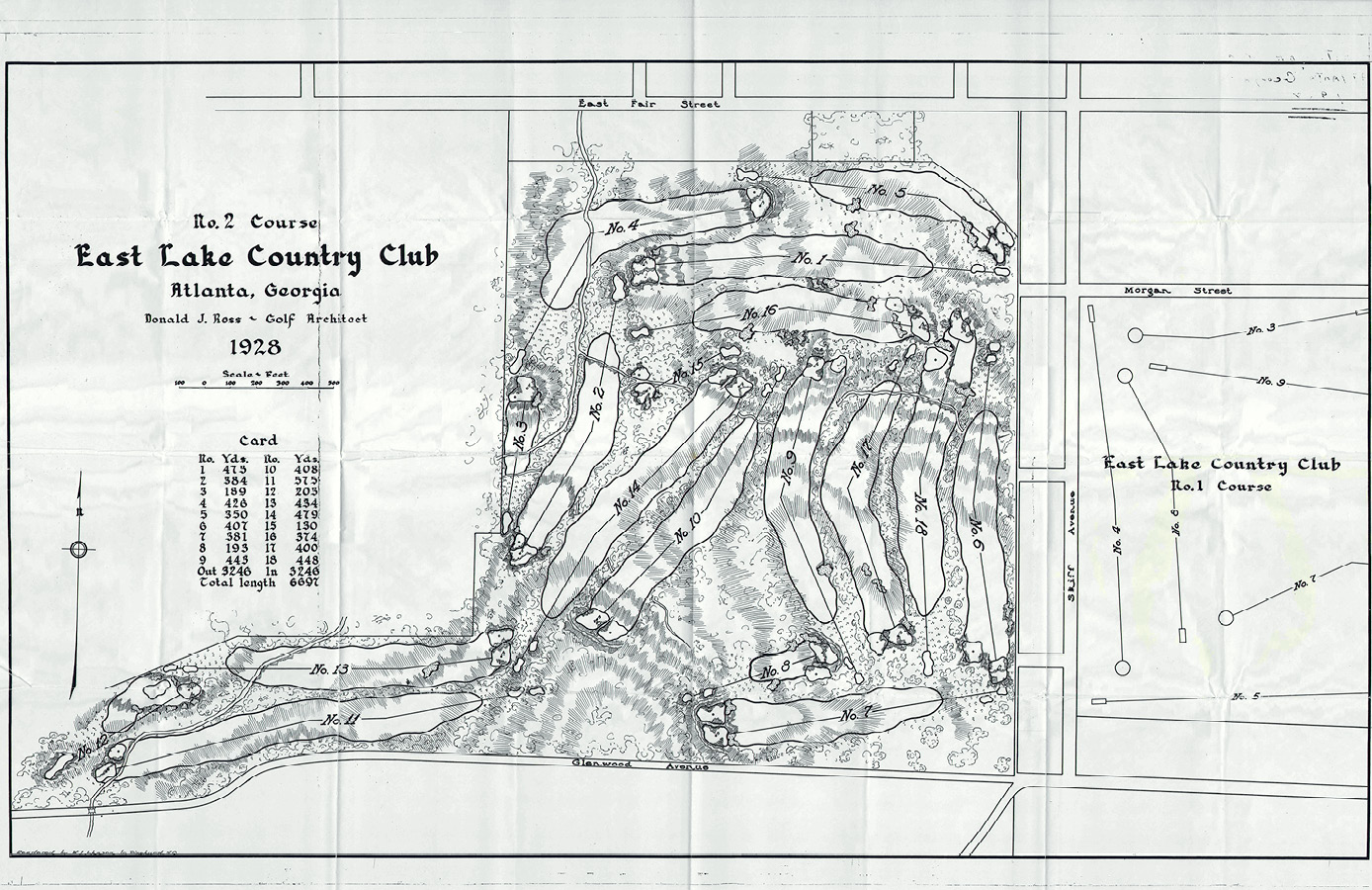
The original Ross drawings were believed lost in the 1925 clubhouse fire. Green went into the basement anyway. He read O.B. Keeler and the old newspapers that described the shots Jones had actually played. Then he found the thing that mattered: a high-resolution aerial from 1949, taken before the Ryder Cup-era changes of the early 1960s. You could see shadow lines of greens, bunker edges, the way the fairways sat on the land. That image became the blueprint.
Green has never claimed he rebuilt 1915. He claimed he recovered Ross strategy and green character, then gave a modern championship a set of tees and hole locations that could be turned up or down. The work started the week after Hovland won and was substantially finished by late May 2024. The last sod went down June 15. Total Turf Golf Services built it. Green flew in most Tuesdays.
Every tee, green, fairway and bunker came out and went back in. Fairways switched from Meyer Zoysia to Zorro Zoysia and grew from about twenty-four acres to twenty-nine, firmer, with more roll, recambered so the ground could speak again. Greens switched from MiniVerde Bermuda to TifEagle and grew, on average, from 5,619 square feet to 6,240. The old ovals became irregular shapes — squared corners, fingers, plateaus, crests that split a green into left and right rooms. Bunkers went from seventy-four to seventy-eight and changed families: sand-faced modern traps became grass-faced Ross hazards with low entries and faces that rise like a wave about to break. A stream between the sixth and seventh was pulled out of invasive brush. The lake that gives the club its name was expanded and asked to do more work. Trees came down in enough volume that the Atlanta skyline walked back onto the property, and the trees that remained started to look like individuals again.
Short grass replaced a lot of the old collar rough. A miss can now be putted, chipped or pitched instead of always chopped. That single change, as much as any bunker, is what made the restored course feel like a different game.
A different first seven
The old complaint about East Lake’s front nine was monotony. Holes ran up the slope and back down it, straight as a rulebook. Green did not reroute the course. He shifted tees and greens sideways until the same corridors started to bend.
The first hole still heads due east, but it is no longer the same hole. For members it remains a par 5. For the TOUR Championship it plays as a long par 4, stretched from 469 yards to 510. Green threw out the old left fairway bunkers and put Ross-style hummocks in their place, the kind that keep a miss in play instead of punishing it for show. He dragged a spine down the right side of the fairway so the long hitter has something to think about, added a bunker that helps the hole dogleg, and moved the green back onto the high point. The putting surface is two levels now, a nod to the dual greens that once sat on the hole. A small pot sits in front. Fall-aways wait long. The first approach tells you the new rules: East Lake will not hold every ball.
The second is the first of a bruising set of par 3s, grown from 197 yards to 205, with a green that ballooned past 9,000 square feet. Tiers, tilts, hollows. A middle-left pin can look like an ace. A middle-right deck behind a bunker is one of the meanest placements on the property. Green put a cross bunker back in the approach and let the putting surface slope in more than one direction, a crest cutting left from right.
The third drops downhill and got longer, 391 to 415. The bunker you can see from the tee is the manageable one. The one that matters hides farther down the fairway and leaves an awkward second. Play out to the left — even the left rough — and the hole becomes a birdie hole. Green moved the back tee so a good drive has to challenge the right as the ground falls away left.
The fourth used to lean slightly right to left. It now leans the other way. The green jumped well right of its old spot, which changed the entire approach, and the championship tee slid to the lake side of the service path. A diagonal set of bunkers asks for both line and length. From that green, on a clear day, the Bank of America Plaza stands up in the distance. The restoration gave Atlanta back to the golf course.
The fifth is the hole people talk about when they talk about Green getting it right. The old fifth was a straightaway, one of the exhibits in the monotony case. Ross had drawn a dogleg left. Green moved the tee well left, sat it in a remnant chute, and bent the hole around a massive oak at the elbow. A new bunker marks the aggressive inside line. The green shifted back and left and now breaks several ways, including out the back left. Hold the outside of the dogleg when the pin is left and the approach opens. Fail that test and the green turns its shoulder.
The sixth is still 525 yards on the card and nothing like the old sixth. Green moved the green about fifty yards right and took the tees with it, turning the hole into a sweeping uphill boomerang. Between six and seven he reclaimed a creek valley, water and habitat together. Inside-dogleg sand, opposing bunkers at the long landing, hummocks to the left, and a putting surface inspired by the original double green — angled so completely that the hole location changes how the entire hole is played. Most of the surface tilts toward the back. The miss can be long, onto the short grass that now stitches the sixth green to the seventh tee.
The seventh falls downhill with the skyline in the picture after the tree work. Green connected six and seven with fairway, shifted the back tees into better turf, moved the fairway right and built a counter dogleg left. A Ross roll on the left sets the approach. The new green sits farther right than the old one. Ridges split the putting surface into rooms. Putts pull toward the lake harder than they look.
The turn, and the water
Then the course changes keys.
The eighth had been a 471-yard wood-and-short-iron par 4 along the lake. Green cut it to 390 and turned it into a hole that can be driven. Tees shifted right to let the lake grow. A carry bunker sits on the water’s edge. Another waits offset to the right. The green is placed at the exact point where fear of the water and the temptation to go for it occupy the same thought. When the tee is back it is still a mid-iron test. When the tee is forward it is a Sunday conversation. Fairway now runs off the green toward the ninth tees, so a miss is not automatically a buried lie.
The ninth was the old eighteenth, before the nines flipped. Green built a new championship tee across the service path, pushed the hole toward 260 yards, and moved the green forward and left, using the left green from the Jones-era course. Water is closer. The target is shallower. A triangular bunker marks the putting surface; short grass falls off both sides. At full stretch it is a long iron or a hybrid over water into a green that will not hold a timid miss — closer to the roughly 230-yard test Jones knew than anything the television era had been playing.
The inward nine
The tenth looks, from the tee, like the parkland par 4 it has always been: down, then up to a perched green. Green pulled the tees forward from the entrance, eased the fairway left to give eleven and twelve room, and put a cross bunker back in the approach so the target feels original again. The new green has rooms, left to right and front to back. A fairway drive should be a birdie look. The pin decides where a miss is allowed to live.
Tree work between ten and eighteen created a temptation the Tour later had to police. Players practiced driving the eighteenth down the tenth fairway to take the lake out of play. The idea was too good. Officials put a stop to the alternate route.
The eleventh is the perspective hole. Rear tees push it past 200 yards, 214 becoming 225. Green restored a large, deep front bunker under an elevated green and let short grass run off the putting surface. The front bunker is made to look even bigger against a smaller crater to the left. The eye lies. The shot does not.
Twelve stays right around 390 yards but plays tighter to the northern boundary. One bunker on the left, just under 300 yards from the back tee, is the honesty tax for anyone bailing from the fence. The approach now arrives from the right, uphill. A long left greenside bunker hides much of the surface behind it.
Thirteen runs south along the western edge, 440 to 450, tees eased left away from the road and the tree line. Green wants the right side used; grass hummocks wait to catch the greedy line. The left greenside bunkers look harmless next to the deep sand on the right. Neither is a place to be short-sided.
Fourteen is the swing hole of the closing stretch. Green lengthened it from 520 to about 580 and gave it back its par-5 status for members and, in 2024, for the TOUR Championship. The course played as a par 71 that year. In 2025 the Tour moved the tee up and played it as a long 4 again. Either way the hole starts the finish: downhill, nasty rough right, a trapezoidal green that opens from the left side of the fairway. Scoreable if you take the right half of the argument. A wreck if you do not.
Fifteen is still the picture hole, the peninsula green that once served Bendelow’s sixteenth and has been East Lake’s postcard for a century. Green took the bunker off the putting surface and removed the back-left bunker that used to be a hiding place. What remains is a mitten-shaped green and a low chipping area behind it that collects the slight miss. Without a grandstand stacked on the back of the green, the target looks smaller than it is. The back tee, unused at first, can stretch the hole toward 230 yards.
Sixteen climbs. The card says 460, a few yards longer than before, and it plays a club more than that. The feature everyone remembers is new: an eight-foot-deep short-grass hollow to the right of the green, the kind of fall-off Jason Gore compared to Turn 2 at Daytona, the kind of scale Jones once called epic. A front-right pin sits between a bunker and that drop. Sunday recoveries from the hollow are the sort of thing a season finale is supposed to produce.
Seventeen looks, from the air, like the hole that proves Green was reading the 1949 photograph and not just waving it around. He took out the three left fairway bunkers of the Rees Jones course and put back a continuous trench along the left — a hazard visible in 1949 and gone sometime before 1955, following a Civil War road bed. Most players will still live on the right. The longest can take the split fairway left of the trench and flirt with the trees. The old bunker in front of the green came out. From a forward tee the hole can be driven. The putting surface has more interior weather than it used to.
Eighteen is 585 yards now, a little shorter on the card than the old 600, and much more of a hole. Green grew the lake until water actually bisects the driving line. He put a hog’s back in the landing area so the fairway plays narrower and the lies hang. The green and its bunkers were rebuilt to reward a high right-to-left shot, especially to a back-left pin. Go long and the up-and-down is harder than it used to be. The Tudor clubhouse and the grandstand canyon give the finish the scale of an Open. It is a walk-off hole again, which is the entire point of a season that ends in Atlanta.
What the players found
Xander Schauffele said he would not have been surprised if the TOUR Championship had moved for a year to let the grass settle. The last sod was only weeks old in August 2024. Stewart Cink, who belongs to the club, talked about variety and complexity, the things the old course had been missing. The 2024 event was an introduction. By 2025 the Tour was using the new greens the way Green drew them — pins on fingers and plateaus — and pulling out the back tees on nine and fifteen that had been held in reserve.
The old East Lake stopped you in the rough and fed every putt toward the front of a circle. The new one asks you to pick a side off the tee, live with firm bounce, and decide whether a plateau pin is worth the miss that falls off a lobe of green into short grass, or into a hollow eight feet below. Length barely moved. Character moved a mile.
What he left
Green’s East Lake belongs with his other Ross recoveries. Irregular greens. Staggered bunkers. Ground that does some of the work. A championship that can be set soft or set mean. It is not a museum. The drawings burned. The 1949 aerial, Keeler, the newspapers, and a career spent listening to Ross produced a course the Scot would recognize without being able to claim every contour.
The clubhouse picked up a new western porch and extra arches in the same season. The neighborhood project that justified Cousins’s purchase of the club in the first place remained the frame around the work. Green said there was a tremendous obligation to protect what that project had already done. The golf course was supposed to be worthy of it.
The TOUR Championship is scheduled to leave annual residency after 2027 and rotate. Calendars move. What stays is the thing Green built in the dirt: a parkland championship that looks like Atlanta again, plays like Ross again, and can be a birdie afternoon or a Sunday examination depending on where they put the tees and the pins. Same name. Same property. A different golf course. That was the assignment.
Originally published
Read this piece on Club Docket →